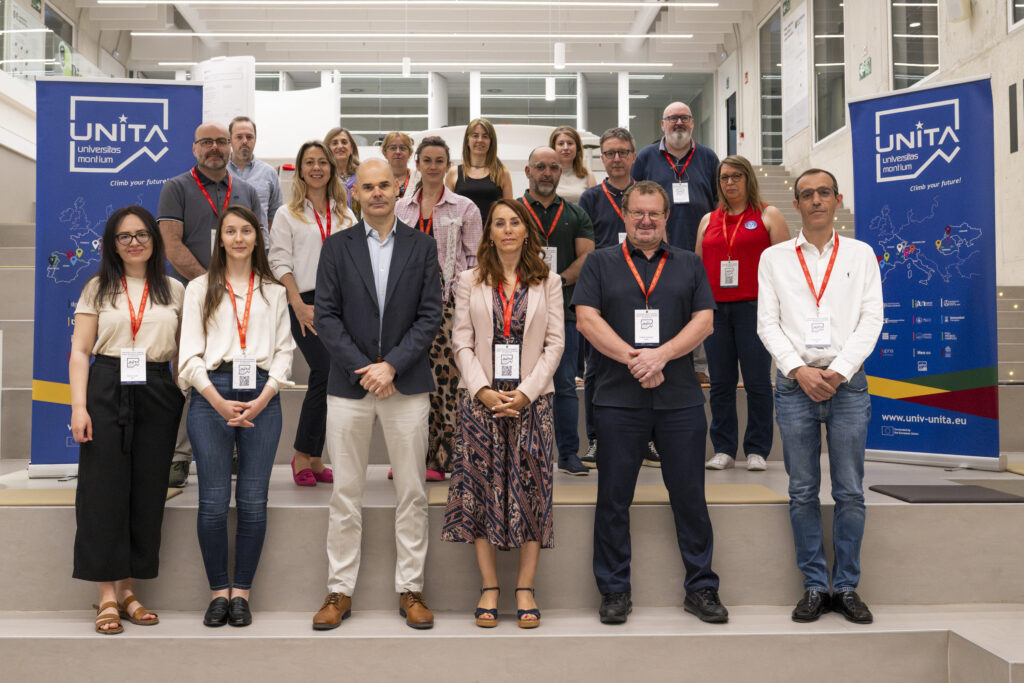
The Public University of Navarre (UPNA) has hosted the international workshop Building a UNITA Common Model for Service Redesign, a collaborative initiative aimed at developing a shared approach to redesigning university services across the UNITA – Universitas Montium European University Alliance.
Through a combination of plenary sessions, practical exercises and group activities, participants examined how university services can adapt to changing and increasingly complex environments. The workshop focused on incremental interventions, strategic planning, collaborative working and the development of prototypes to test potential improvements.
The opening session was led by independent consultant Joaquín Romero Roldán, who facilitated the workshop and presented a “lean-light” approach to university service redesign. This methodology is based on gradual, targeted and non-invasive interventions that allow institutions to introduce improvements without undertaking large-scale organisational restructuring from the outset.
The approach recognises that universities are operating in increasingly complex environments, in which cause-and-effect relationships cannot always be predicted through conventional planning models.
According to Romero Roldán, the future competitiveness of universities “will not depend solely on plans, indicators or technology, but on their ability to mobilise people, integrate knowledge, generate value through face-to-face work and transform complex problems into shared processes of learning, innovation and transformation”.
He proposed three interconnected levels of action. The executive level relates to strategic decision-making; the leadership level focuses on coordinating and mobilising teams; and the creative level seeks to involve the wider organisation in innovation processes. This framework provided the basis for the practical activities carried out during the workshop.
From institutional analysis to the first redesign challenge
During the first of the workshop’s three days, participants explored possible future scenarios and assessed the level of institutional readiness within each university. These activities helped them identify relevant uncertainties affecting the higher education sector, evaluate internal capabilities and prioritise potential areas for action according to their expected impact and feasibility.
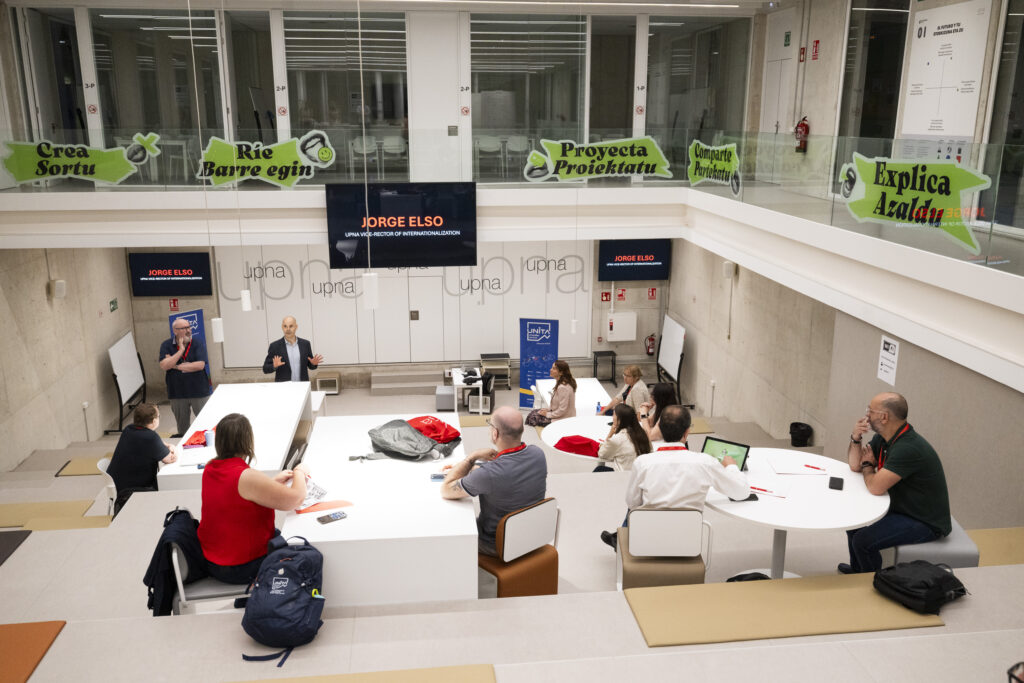
The second day focused on the design of institutional laboratories: collaborative spaces intended to promote processes of change, experimentation and service redesign within each university. Participants also considered how to establish core teams responsible for launching these laboratories and coordinating the redesign of specific services.
The final day was devoted to stakeholder mapping, service blueprints and the definition of an initial service redesign challenge. Service blueprints are visual tools that make it possible to analyse the different processes, interactions and resources involved in the delivery of a service.
Each group prepared an initial proposal for improving a university service. The proposals followed a practical approach based on identifying user and institutional needs, designing a feasible intervention and defining criteria for assessing its results.
The workshop represents a further step towards building a common UNITA framework that can be adapted to the different institutional contexts of the Alliance’s partner universities. By sharing methodologies and working collectively on concrete challenges, the initiative seeks to strengthen universities’ capacity to respond to change and improve the services they provide to their communities.
The work will continue after the summer through four online sessions. During this next phase, the participating teams will further develop stakeholder maps identifying the students, academic staff, and professional, technical, management and administrative staff connected with each of the services selected for redesign.