


Cultural heritage: UniBs is hosting the second stop of the exibition “I primi custodi della memoria. Le sepolture del Paleolitico.”

The exibition “I primi custodi della memoria. Le sepolture del Paleolitico.”, showcasing the collection of casts of Paleolithic burials from the Museum of Human Anatomy at UniTO, is open at Palazzo Bettoni (Piazza Bruno Boni, Brescia) from the 30th of April to the 21st of June. This exhibition represents an outstanding collaboration between the universities of the Alliance. The casts of the Paleolithic era provide valuable insights into how populations of that time approached the death of a fellow human. Funerary practices offer a unique opportunity to explore the deeper elements of human thought during a period preceding the emergence of artistic expression. The death rituals of the Paleolithic era were not driven by material necessities but by concerns of a different nature, often reflecting beliefs about the fate of an individual—or their body—after death. For this reason, they represent a significant milestone in the social history of humanity, shedding light on the life of the deceased and their community. The inauguration took place on Wednesday, April 30th, in the presence of the Rector of the University of Brescia, Professor Francesco Castelli; the Rector of the University of Turin, Professor Stefano Geuna; Professor Giacomo Giacobini, Curator of the exhibition and Emeritus Professor at the University of Turin; Professor Angelo Mazzù, Project Coordinator and Full Professor of Mechanical Design and Machine Construction at the University of Brescia; and Associate Professor Irene Giustina, Professor of Architectural History at the University of Brescia and representative of the UNITA Cultural Heritage working group (hub). The exhibition was first hosted by the University of Turin from January 16 to April 26, 2025. During this period, it welcomed over 6,400 visitors, averaging 75 attendees per day. The final day, Saturday, April 26, saw the highest attendance, with 508 visitors. As a traveling exhibition, it will be hosted in turn by several universities within the UNITA Alliance, further strengthening collaboration and fostering shared cultural engagement among partner institutions. The exhibition at the University of Brescia can be visited until June 21, 2025, from Monday to Friday, from 10:00 AM and 12:00 PM and from 2:30 PM to 4:30 PM.
International PhD in Digital Humanities between Turin, Genoa, and Pau: an excellent achievement within the UNITA Alliance

Titled From Basque to Francoprovençal: promoting regional or minority languages through the design of a European digital museum, the doctoral dissertation by Marie Domengès received top honors in a joint supervision program between the Université de Pau et des Pays de l’Adour (UPPA), the University of Turin, and the University of Genoa. The research was conducted as part of the PhD program in Digital Humanities – Digital Technologies, Arts, Languages, Cultures, and Communication. In particular, the research explored how museums — often overlooked in the efforts to safeguard regional or minority languages — can highlight multilingualism and contribute to the preservation, promotion, and transmission of less-used local languages, which are often at risk of extinction. In her work, supervised by Professors Laurence Roussillon Constanty (UPPA) and Silvia Pireddu (University of Turin), Dr. Domengès carried out a study on 26 museums in France and Italy, especially in cross-border areas, to observe early multilingual approaches within these cultural institutions and identify attempts to promote regional or minority languages. She further delved into the subject through a four-month case study in two museums: the Musée Basque et de l’histoire de Bayonne in the French Basque Country, in Bayonne, France and the Museo dell’Artigianato Valdostano di tradizione in Fénis, Italy. The goal was to understand how these institutions work to safeguard the Basque and Francoprovençal languages. Dr. Domengès proposed best practices for the creation of multilingual and educational materials that could be used to inclusively and accessibly promote and enhance linguistic and cultural heritage. This research not only contributes to the recognition and promotion of regional and minority languages but also perfectly aligns with the founding principles of the UNITA Alliance, which fosters cooperation among European universities to address global cultural, educational, and scientific challenges. The PhD program in Digital Humanities, combining digital technologies, arts, languages, cultures, and communication, enabled Marie Domengès to engage with the challenges and opportunities of a multilingual approach to cultural heritage communication. This international doctoral initiative, involving several European universities, once again highlights the importance of academic cooperation in a global context and represents another step forward in the integration and strengthening of international collaboration within the UNITA Alliance.
15 projects selected for the UNITA Starting Grants on Cultural Heritage and Green Energies

15 projects have been selected in the framework of the UNITA Starting Grants for Research on cultural heritage and green energy for a sustainable future, involving faculty members and researchers from ten partner universities within the UNITA Alliance. These initiatives bring together international research groups composed of scholars, post-docs, and PhD students, focusing on Cultural Heritage and Green Energies. The goal is to strengthen transnational academic collaboration and promote innovation. The call, launched to encourage the creation of new projects or the consolidation of existing collaborations, requires participation from at least three UNITA universities per proposal and has a maximum duration of 12 months. Ten projects have been selected within the Cultural Heritage field, addressing topics such as the enhancement of intangible heritage, multilingual rural literature (Literature about/in the village), the use of digital tools for sustainable tourism (Smart Rural Heritage), and the historical memory of conflicts (Sharing historical interpretations of rural heritage). Five projects have been approved in the Green Energies category, focusing on innovative themes such as bioelectrochemical systems for sustainable hydrogen production (BIOHYDROMILL), energy self-sufficiency for isolated rural activities (IDEA-ERA), and energy-conscious communities in mountainous regions (Redefining sobriety in mountainous areas). These projects mark a significant step forward in building a shared research network among European universities in the UNITA Alliance, with a strong impact on local communities and the challenges of ecological and cultural transition. A new edition of the UNITA Starting Grants for Research is open until May 12, 2025, for projects in: All details are available on the UNITA website
UNITA Blended Intensive Program: the “One Step Beyond” international entrepreneurship course in Turin
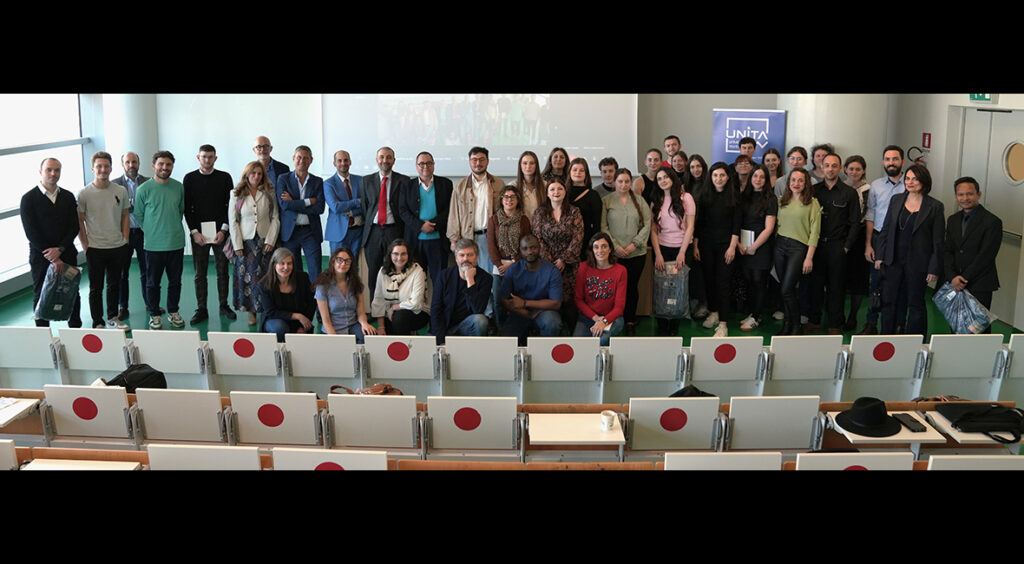
More than 30 participants including doctoral students, master’s students, researchers and professors from different UNITA alliance universities gathered in Turin to participate in the Blended Intensive Program “One Step Beyond: an entrepreneurial course within the UNITA alliance.” The program, created to promote entrepreneurship within international academic contexts, kicked off with an initial online training phase, during which lecturers from partner universities delivered introductory lectures and activities. The course then got into full swing in Turin, with an intensive in-presence workshop that led to the emergence of five interdisciplinary and international teams, composed in a balanced way – including from a gender perspective – of participants from different universities in the alliance. Guided by mentors and experts, the teams combined skills and creativity to develop innovative entrepreneurial projects, with the goal of turning promising ideas into concrete, sustainable and high-impact solutions. At the end of the course, five innovative projects were developed on social and environmental issues, specifically: sustainable agriculture, rural tourism, housing for seasonal workers, digital nomadism, and cervical cancer prevention. The experience concluded at the “Campus Luigi Einaudi” with a final event open to the public, during which the teams presented their pitches to a jury of experts from the academic and corporate worlds. The three most deserving projects awarded for originality, feasibility and innovative potential were: The initiative – promoted by in the framework of the UNITA action “Inter-territorial Interfaces for Innovation” – represented a unique opportunity to foster collaboration among European universities, promote entrepreneurial spirit among young people, and strengthen the link between research, teaching, and the world of work.
Legal Entity: The future for European University Alliances
2 April, 10:30-12:00: Prof. Barbara Gagliardi from UniTo will talk about the UNITA experience with the legal entity during the online session “Legal Entity: The future for European University Alliances”, in the framework of the 2025 Arqus Annual Conference, which will take place on 2 and 3 April at Leipzig University (Germany). Broadcasted live on the Arqus YouTube channel.
Great Participation in the UNITA Annual Conference on Fascism and Authoritarianism
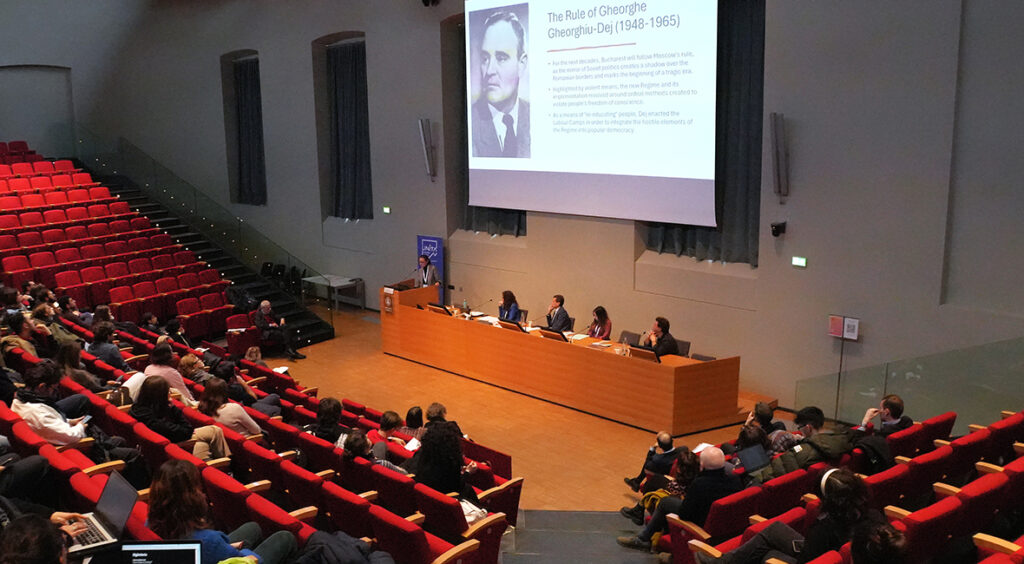
A heterogeneous audience of 130 attendees, including university professors, administrative and technical staff, university students, and high school students from Turin, followed the discussions of the UNITA-Universitas Montium Annual Conference, titled “Fascism, Authoritarianism, Military Regimes, and European Integration: Histories, Interpretations, Perspectives.”, that took place in the Aula Magna of the Cavallerizza Reale in Turin and featured distinguished national and international scholars. Organized as part of UNITA’s “European Citizenship Initiative”, in collaboration with all the universities of the Alliance, Polo del ‘900, and Europe Direct Torino, the conference opened with institutional greetings from the Rector of the University of Turin, Stefano Geuna, and Matteo Bagnasco, representing Polo del ‘900. A highlight of the day was the Lectio Magistralis delivered by Professor Anne-Sophie Nardelli-Malgrand from Université Savoie Mont Blanc, who analyzed fascism, neo-fascism, and post-fascism from a transnational perspective, covering the period from 1932 to the present day. The first session, titled “Democracy and Authoritarianism: Assessing the Past and Risks for the Future,” featured experts from various European universities. Among the most appreciated contributions was that of Professor Mauro Forno from the University of Turin, who examined Italian fascism as the first authoritarian experiment in Europe. Dr. Amaia Álvarez Berastegi from Universidad Pública de Navarra illustrated Spain’s long transition from dictatorship to democracy. Other key interventions included Professor Andreea Verteș-Olteanu from Universitatea de Vest din Timișoara, discussing Romania’s transition from authoritarianism to European integration, and Professor Nuno Amaral Jerónimo from Universidade de Beira Interior, analyzing Portugal’s transformation from an intercontinental empire to a European democracy. After a lunch break, the conference resumed with the second session, titled “A Broader Perspective: Common Problems and Prospects.” Among the speakers, Federico Trocini from the University of Bergamo examined the evolution of political language in authoritarian regimes between the 20th and 21st centuries, while Martina Coli from the University of Florence discussed the role of EU law as a potential safeguard against emerging authoritarianisms. The conference concluded with remarks by Professor Anna Mastromarino from the University of Turin, emphasizing the importance of an interdisciplinary approach in understanding both past and present authoritarian tendencies. The event sparked extensive debate among participants, confirming the relevance and urgency of the topic. The success of the conference further strengthens UNITA-Universitas Montium’s role as a key academic forum for international discussions on major historical and political issues. Want to stay updated on UNITA’s initiatives? Follow @universitasmontium on Instagram.
A Franco-Colombian research project born of the GEMINAE meetings

The GEMINAE program fosters global academic cooperation in Romance language-speaking regions. A collaboration between Sabine Forero Mendoza (UPPA) and Universidad del Rosario led to a research project on Colombia’s collaborative artistic practices (1991-2021), funded by ECOS Nord. The study explores art’s role in social change and resilience. Supported by French and Colombian institutions, it runs until 2027, reinforcing ties between Europe and Latin America. Le programme GEMINAE, réseau extra-européen de l’alliance UNITA, vise à renforcer la coopération internationale entre des universités du monde entier où sont parlées des langues romanes. C’est dans ce cadre que s’est nouée la collaboration entre Sabine Forero Mendoza, professeure spécialisée en philosophie et histoire de l’art à l’Université de Pau et des Pays de l’Adour, et ses partenaires colombiens de l’Université du Rosaire (Universidad del Rosario, Bogotá). Lors des rencontres GEMINAE tenues à Pau en septembre 2023, ces partenaires ont pu initier un ambitieux projet de recherche consacré aux pratiques artistiques collaboratives en Colombie, qui vient de décrocher un financement du programme ECOS Nord. Une reconnaissance par le programme ECOS Le projet, intitulé « Pratiques artistiques collaboratives en Colombie : enjeux sociaux, processus créatifs et élaborations d’espaces communs (1991-2021) », a récemment obtenu une bourse ECOS Nord. Le programme ECOS (Nord et Sud) soutient des collaborations scientifiques d’excellence entre la France et des pays d’Amérique latine en finançant des échanges entre chercheurs et doctorants sous forme de missions et de stages de perfectionnement. Il est important de noter que les bourses ECOS sont rares dans le domaine des sciences humaines et sociales, ce qui renforce la valeur et la reconnaissance de ce projet. Une étude sur les liens entre art et engagement politique L’objectif de la recherche est d’explorer comment les pratiques artistiques participatives ont accompagné des transformations sociales et politiques majeures en Colombie, depuis la mise en œuvre de la Constitution de 1991 jusqu’aux mobilisations citoyennes de 2021. En s’appuyant sur des entretiens et une analyse approfondie des contextes, l’équipe franco-colombienne étudiera des œuvres collectives produites dans des disciplines variées : arts plastiques, théâtre, littérature et cinéma. Ces réalisations revêtent bien souvent une finalité réparatrice en Colombie, contribuant aux processus de résilience et de reconstruction sociale dans un pays marqué par des conflits internes. Une collaboration scientifique structurée Le projet est mené par une équipe internationale et interdisciplinaire : en France, des chercheuses appartenant à trois universités sont impliquées (Université de Lorraine, Université Rennes 2 et Université de Pau et des Pays de l’Adour), ainsi qu’une doctorante de Cergy Paris Université. En Colombie, des chercheurs en arts plastiques, en philosophie et sciences politiques, ainsi qu’une doctorante en droit spécialisée dans la justice transitionnelle et le droit des minorités, contribuent aux travaux. Cette coopération s’appuie sur un cadre institutionnel solide, incluant des accords bilatéraux et un financement jusqu’en 2027. Le premier départ de mission est prévu pour août : il marque le début des travaux de terrain, qui incluront un recensement des propositions artistiques et des entretiens avec des artistes et acteurs culturels. L’Université du Rosaire, partenaire du projet, entretient des liens privilégiés avec l’Université de Saragosse, qui, en tant que membre de l’alliance UNITA, l’a désigné comme un partenaire stratégique. C’est dans ce cadre que cette université colombienne a participé aux rencontres du réseau GEMINAE organisées à Pau en 2023, renforçant ainsi les collaborations académiques entre l’Europe et l’Amérique latine que l’UPPA a à cœur de développer. Le projet bénéficiera du dynamisme de la faculté d’art récemment créée au sein de l’Université du Rosaire, qui constitue un espace clé pour l’étude, l’évaluation et la valorisation de pratiques artistiques à fort impact social, dans un pays particulièrement touché par diverses formes de violence.
Cultural Heritage Meets Technology at the Casa Mureșenilor Museum in Brasov

On March 6, 2025, the Casa Mureșenilor Museum in Brasov hosted an engaging online presentation by Valer Rus, the museum’s manager, for professors and students involved in the CONNECT WONDERS project. This project, funded through UNITA Starting Grants, aims to explore the connections between literature, tourism, and European cultural heritage, contributing to knowledge integration based on The World Literature Knowledge Graph, a semantic resource developed by researchers at the University of Turin. With an impressive archive of over 25,000 documents, the Casa Mureșenilor Museum was the perfect partner for organizing an event aligned with the project’s theme. The museum is widely recognized for adopting innovative solutions that make history accessible to the public. During the virtual tour, participants discovered three initiatives that make this museum particularly appealing to younger generations. The first, launched in 2017, enables visitors to explore the museum through virtual reality, offering an immersive experience with historical archives. Since 2019, an interactive artificial intelligence-powered avatar has provided personalized information about exhibits, enhancing the visitor experience. In 2022, a gamified virtual tour was introduced, blending history with digital interactivity and inviting users to uncover the secrets of the Mureșianu family. The museum manager’s captivating presentation sparked curiosity and encouraged participants to explore the museum further. As a result, a future activity within the CONNECT WONDERS project, scheduled for October 2025, will take place at this museum.
UPNA celebrates the NOCHE UNITA, a moving event on the UNITA values

UPNA organised, within the framework of the UNITA WEEK, the so-called UNITA NIGHT, a moving event with the aim of recalling and highlighting the values that identify UNITA and to reinforce the feeling of belonging to the alliance. The session interspersed short talks by researchers from five different countries of the Alliance, with musical pieces representative of each country by the Escolanía del Orfeón Pamplonés, one of the most prominent children’s choirs in Navarre. The topics discussed, all of them substantial values for UNITA, were European identity, sustainable innovation, the role of Romance languages and the links they create, nature-friendly solutions and, finally, the historical relations between the member countries of the alliance. Each of the speakers spoke in their native language and the audience, made up exclusively of those attending UNITA Week Pamplona, was able to follow the proceedings thanks to a simultaneous translation into English, projected on a screen. The speakers were the following: Francisco Beltrán Lloris (Universidad de Zaragoza), Elisa Corino (Università degli studi di Torino), Frank D’Amico (lUniversité de Pau et des Pays de l’Adour), Bruno Ferreira Costa (Universidade da Beira Interior) and Alexandra Petcu (l’Universitatea de Vest din Timişoara). The event was presented by UPNA student Meghavi Chapman Azpirotz.
UNITA Week Pamplona addresses key issues for the future of the alliance

Between 25 and 28 February, Public University of Navarra (UPNA) hosted in Pamplona UNITA Week 2025, the Alliance’s most important annual meeting and work event. More than 150 people, representing all the universities that make up UNITA, met for three intense days of work to assess the state of progress of the project and to establish future strategies for the consolidation of the Alliance. New organisational structure In the framework of the meetings and activities scheduled at UNITA Week, key issues for UNITA were addressed, such as a roadmap towards a UNITA blueprint, conformed by its fundamental strategies, the preliminary results of the project´s quality review, the progress in the impact observatory, new refinements in the sustainable financial model and the identification of the needs for digitalisation of the different tasks. Other key issues concerning the structure, organisation and consolidation of the alliance were also addressed. These included the approval of a new organisational structure more aligned with the governance of universities, as well as the signing of the so-called Brescia Declaration, drawn up in October 2024 in Brescia, which is committed to an ambitious institutional model capable of carrying out, on a European scale, all the activities of a university. The UNITA Week also served as the setting for the change in the Presidency of the Alliance, a position now held by Ramón Gonzalo, Rector of UPNA, replacing Marilen Gabriel Pirtea, Rector of Universitatea de Vest in Timisoara. The Pamplona meeting also set up a specific programme of meetings for the students who are part of the UNITA Student Assembly. These parallel meetings were mainly aimed at finalising the details of the upcoming Student Assembly elections and the creation of an alumni network for former students. Values, training and sustainability Among the parallel activities, the organization of Noche UNITA stood out, an outreach event in which talks by five researchers from UNITA universities were interspersed with songs performed by a children’s choir in five languages of the alliance. The goal: to remember and highlight the values that define and unite the university communities that are part of UNITA. The programme also included a lecture on European joint degrees by Dorothy Kelly, coordinator of the ARQUS Alliance of universities and professor at the University of Granada, and a training session on Agile methodology for project management. It is also noteworthy that the organisation of this meeting by the UPNA was carried out in accordance with one of UNITA’s fundamental values: sustainability. In this sense, criteria were followed to reduce the consumption of paper and plastic as much as possible, replacing it with other more ecological alternatives. The aim was to reduce as much as possible the ecological footprint of an event that brings together such a large number of people.