


GENERAL DIRECTOR UNITA Universitas Montium-GEIE
The European University “UNITA” is hiring a GENERAL DIRECTOR for the «UNITA UniversitasMontium-GEIE» who will plan and promote the activities of the EEIG as, for example: develop andmanage training activities and certification activities for profit and non-profit, implement theliaison activities with relevant stakeholders in Brussels and in the national contexts, monitorEuropean funding opportunities, develop sustainability strategies for the EEIG in the long term. The general director is required to oversee all the business operations of the EEIG, including itsfinancial performance. Part of a general director’s job is to supervise executives and delegate workto them. They may also be required to assess problematic situations and developments and resolvethem. Moreover, they must ensure that their company is constantly moving towards both its long-term and short-term goals. Terms of Employment: Email your CV and cover letter to UNITA at unita@unito.it until September 302024.(mailto:unita@unito.it) Access the full announcement here
Open Positions at UNITA-Universitas Montium, IT Department

We are excited to announce two open positions at the European Alliance, UNITA-UniversitasMontium. We are seeking qualified candidates for the following roles: The full call for these positions, including detailed job descriptions and requirements, available here: To apply, please send your resume and a cover letter via email to unita@e-uvt.ro (mailto:unita@euvt.ro) by 30 September, 2024. anuncio=/sites/international/contents/unita/eventos/2024/convocatoria-tfg-tfm&opcion=1) Università degli Studi di Torino (UNITO): https://www.unito.it/avvisi/premio-unita-dissertazioni-triennali-e-tesi-di-laurea-magistrali-sul-tema-della-cittadinanza (https://www.unito.it/avvisi/premio-unita-dissertazioni-triennali-e-tesi-di-laurea-magistrali-sultema- della-cittadinanza) Università di Brescia (UNIBS): https://www.unibs.it/it/unita (https://www.unibs.it/it/unita) office@unibs.it (mailto:unita.office@unibs.it) Universidade da Beira Interior (UBI). (/Evento/22715) Istituto Politecnico de Guardia (IPG): (https://politecnicoguarda.pt/en/about-us/unita/) unita@ipg.pt (mailto:unita@ipg.pt) Université de Pau et des Pays de L’Adour (UPPA): (https://organisation.univ-pau.fr/fr/grandsprojets/ unita.html) unita@univ-pau.fr (mailto:unita@univ-pau.fr) Université Savoie Mont Blanc (USMB) (https://www.univ-smb.fr/international/unita/) office@univ-smb.fr (mailto:unita.office@univ-smb.fr) Universitatea Transilvania Braşov (https://www.unitbv.ro/en/internationalization.html) unita@unitbv.ro (mailto:unita@unitbv.ro) Universitatea de Vest din Timișoara (UVT) (https://www.uvt.ro/unita/) unita@e-uvt.ro (mailto:unita@e-uvt.ro) Call Service Manager Call Head of Development If you have any questions regarding these positions, feel free to contact us at unita@e-uvt.ro (mailto:unita@e-uvt.ro) We look forward to receiving your applications! Job opportunity in Brussels: Project & Policy Officer Are you passionate about European HigherEducation policy and skilled in project management? Join our team at FOR-EU4ALL, a network ofEuropean Universities alliances of the European Commission’s flagship programme, the EuropeanUniversities Initiative, funded by Erasmus+. You’ll play a key role in supporting 64 EuropeanUniversities alliances, driving policy dialogue, and managing impactful projects. 📍 Brussels, Belgium 💼 4 years, full-time (preferred) 📅 29 September 2024 👉 Contact Olga Wessels at recruitment@foreu4all.eu (mailto:recruitment@foreu4all.eu) 🔗 https://www.eciu.eu/news/vacancy (https://lnkd.in/dc33e7rU) Ready to make a difference? Apply now!
A great success for the third edition of the Summer School “Université d’été

On August 31, the third edition of the Summer School “Université d’été. Enhancement of Territorial Cultural Heritage for Responsible Tourism in the Cross-Border Area, organized by the “Open Tourism” Research Laboratory of the Department of Foreign Languages and Literatures and Modern Cultures of the University of Turin, in collaboration and with the support of the Cultural Association Antonella Salvatico – International Center for Research on Cultural Heritage. Dal 26 al 31 agosto 2024, 33 studentesse e studenti sono stati ospitati presso i locali della Casa Alpina di Sant’Anna di Valdieri, in valle Gesso, nel Parco Naturale delle Alpi Marittime. In quella sede hanno seguito lezioni frontali e hanno partecipato a workshop seminariali coordinati da docenti di UNITO, da docenti di altri atenei, anche stranieri, e da specialisti nell’ambito della conoscenza, valorizzazione e comunicazione del patrimonio culturale e ambientale, lavorando in sinergia con gli operatori del Parco e con rappresentanti del comparto ricezione della valle. Attorno all’obiettivo di conoscere, creare/ri-creare e promuovere il valore di tutto quanto rientra nel concetto di “patrimonio culturale”, coerentemente con la fisionomia e la mission del Dipartimento di Lingue e Letterature Straniere e Culture Moderne, sono state proposte sessioni dedicate a materie e metodologie diverse (storia, storia dell’architettura, antropologia culturale, letteratura e arti performative, sociologia del territorio e della comunicazione turistica, economia), mettendo in rilievo di percorsi di ricerca e applicazione interdisciplinari, in cui il focus “turismo” quale possibile prospettiva di future attività professionali viene sempre declinato nella forma di turismo culturale. Parimenti importante, allo scopo di stimolare nelle/nei partecipanti una maggiore consapevolezza della realtà in cui studiano, di garantire una più approfondita preparazione universitaria e di coadiuvare la maturazione di competenze specializzate su tematiche interculturali e transfrontaliere, costante è stata la comparazione tra casi e modelli di area italiana con quelli di area francese e svizzera, concentrando sulle realtà del mondo alpino e prealpino le tematiche affrontate nelle lezioni e nei workshop inerenti a epoche della storia, a trasformazioni insediative ed economiche di territori e comunità, all’evoluzione delle estetiche, alla circolazione di persone, idee, conoscenze e maestranze, alla condivisione di tradizioni, alla percezione dello spazio e all’immaginario letterario sedimentatosi attorno ai luoghi. L’attenzione mirata alla macroregione italiana, francese e svizzera unita dall’arco alpino occidentale ha permesso di impostare discorsi inerenti alle criticità, alle sfide e al ruolo culturale specifici delle aree di frontiera/passaggio dell’Italia occidentale, aprendo però sempre i discorsi a comparazioni con altri contesti europei, nelle loro analogie e differenze. La natura di corso residenziale, che porta fuori dalle consuete aule di lezione e dalle sedi universitarie, riunendosi in una cornice che favorisce la riflessione, l’esperienzialità e il dialogo tra partecipanti e docenti, tra partecipanti e specialisti/operatori, e tra studentesse/studenti, ha costituito come ogni anno un valore aggiunto importante per le proposte didattiche. La settimana di Université d’été ha incluso altresì visite guidate a musei, ecomusei e siti di interesse patrimoniale e naturalistico con tematizzazioni diverse e impostati secondo attuali e dinamiche declinazioni di esposizione, narrazione, conservazione e comunicazione del patrimonio storico, architettonico, documentale-archivistico, naturale. I partecipanti, accompagnati dalle guide del Parco e dai docenti, hanno esaminato così iniziative locali di recupero di antichi percorsi alpini mirate alla valorizzazione e alla riproposta di trascorse attività economiche, di antiche pratiche agricole, di realizzazioni architettoniche, di usanze e tradizioni popolari, al fine di integrare l’esperienza degli itinerari turistico-culturali analizzati con il contesto culturale e con la percezione del territorio che storicamente ha sostenuto la “produzione” di tali sistemi di beni. Nella sessione di chiusura, la parola è passata alle studentesse e agli studenti: i 33 partecipanti sono stati chiamati a esporre una bozza di progetto di valorizzazione su cui, a piccoli gruppi, hanno riflettuto e discusso nel corso della settimana, dopo aver ricevuto nella prima giornata indicazioni metodologiche per l’elaborazione. Pensata soprattutto per gli iscritti ai percorsi di studio nell’ambito delle lingue e delle culture per il turismo (corso di Laurea triennale in Lingue e Culture per il Turismo, corso di Laurea magistrale in Comunicazione internazionale per il Turismo, Master in Promozione e Organizzazione turistico-culturale del Territorio – MaPOT), l’Université d’été ha accolto studentesse e studenti di altri percorsi del primo e del secondo ciclo universitario e dottorandi, motivati da interessi formativi personali oppure dalla ricerca di approfondimenti mirati per la propria tesi. Due studentesse UNITA, provenienti dall’Università di Beira e dall’Université de Savoie Mont-Blanc, hanno condiviso le proprie competenze ed esperienze di studio con studentesse e studenti di UNITO. L’iniziativa incardinata nel Dipartimento di Lingue e Letterature Straniere e Culture Moderne e realizzazione con il sostegno dell’Associazione Culturale Antonella Salvatico – Centro Internazionale di Ricerca sui Beni Culturali, è stata resa possibile grazie al contributo della Fondazione CRT e della Fondazione CRC Cassa di Risparmio di Cuneo, del Progetto PRIN 2020 Abitare i margini, oggi. Etnografie di paesi in Italia, del Progetto CREST – Cultural Resources for Sustainable Tourism del Partenariato Esteso 5 PNRR “CHANGES”. All’avvio dei lavori hanno accolto studentesse e studenti il Prof. Matteo Milani, Direttore del Dipartimento di Lingue e Letterature Straniere e Culture Moderne, Marco Zaccarelli, Presidente della Cooperativa Radici Piemontesi – Progetto Italea Piemonte, Piermario Giordano, Presidente del Parco Naturale Alpi Marittime; ai saluti di chiusura ha partecipato la Prof.ssa Marcella Costa, Vice Rettrice Vicaria alla Didattica Internazionale di UniTO e referente scientifico del Progetto internazionale UNITA. Cristina TrincheroProfessoressa Associata di Letteratura FranceseDipartimento di Lingue e Letterature Straniere e Culture Moderne
Job opportunity in Brussels: Project & Policy Officer
Are you passionate about European HigherEducation policy and skilled in project management? Join our team at FOR-EU4ALL, a network ofEuropean Universities alliances of the European Commission’s flagship programme, the EuropeanUniversities Initiative, funded by Erasmus+. You’ll play a key role in supporting 64 EuropeanUniversities alliances, driving policy dialogue, and managing impactful projects. 📍 Brussels, Belgium 💼 4 years, full-time (preferred) 📅 29 September 2024 👉 Contact Olga Wessels at recruitment@foreu4all.eu 🔗 https://www.eciu.eu/news/vacancy Ready to make a difference? Apply now!
A unique rural mobility experience for UNITA students in France
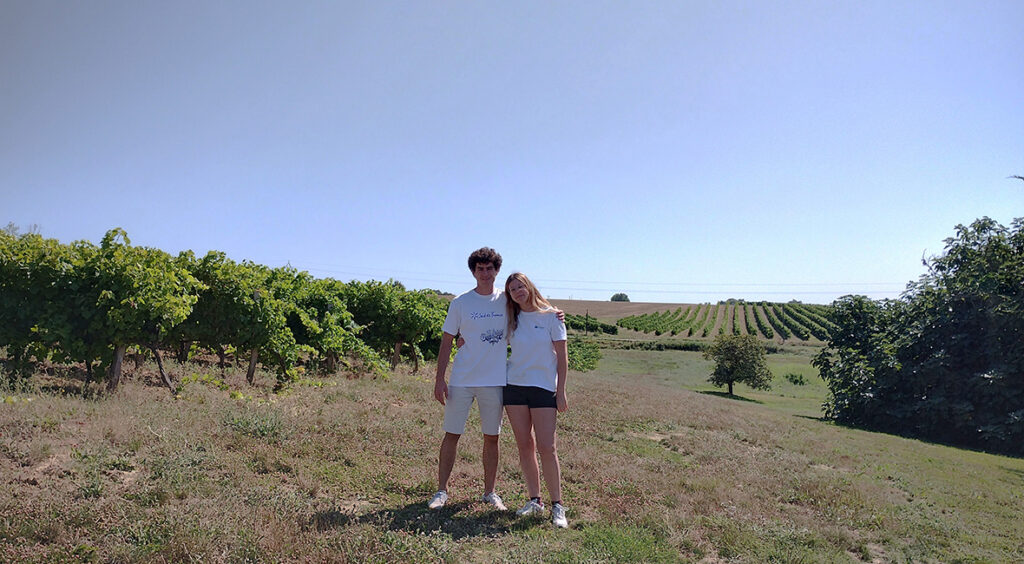
This summer, Sofia Gilardi, a graduate student in tourism enrolled in her third year at the University of Turin (Italy) in Languages and Cultures for Tourism, and Guillermo Piedrafita, a student in management and law at the University of Zaragoza (Spain), completed a UNITA rural mobility internship on a wine estate in Mirepoix, Gers, a commune of 223 inhabitants. They were warmly welcomed by Mr. Esquiro and his family at the Domaine de la Higuère. During the internship, Sofia and Guillermo were trained to give guided tours of the estate in French, English, Italian and Spanish. Sofia and Guillermo stayed with other international students in the farmhouse on the estate. They each had their own room. Meals were prepared by Mrs. Esquiro, and the students helped with preparation and logistics. The winemaker taught them about the history of the estate, which has been in the family since 1784 (9 generations of winemakers), the history of the building, and the winemaking process for red, rosé and white wines. They carried out certain stages in the production process, such as tending the vines and bottling the wines. Mr. Esquiro introduced them to oenology, so that they would be able to taste the different wines for visitors. They also learned sales techniques for the estate store. The trainees really enjoyed this rural experience. It enabled them to improve their French, discover the winegrowing business in its entirety, and enjoy a unique experience.
Fighting Prejudices through Intercomprehension and Interculturality

From July 15 to 20, the University of Pau and the Adour Region (UPPA) hosted the Blended Intensive Programme (BIP) “Fighting Prejudices: Intercomprehension and Interculturality” on its Pau campus. This program, which brought together students and teachers from across Europe, aimed to promote intercultural communication and international cooperation. For a week, participants had the opportunity to develop their intercomprehension skills through workshops combining theory and playful practice, led by teachers from the UNITA alliance. In addition to these workshops, the program included various cultural and collaborative activities, such as a thematic tour of Pau focused on Street Art, allowing students to discover the city from a different perspective. The association Préjugix was also invited to give a one-day workshop to raise students’ awareness of the fight against prejudices, encouraging new perspectives on others and combating discrimination. Throughout the five days, participants and speakers communicated using their native Romance languages, leveraging intercomprehension strategies. This mode of communication offers several advantages, particularly by including students who do not have a strong command of English and may not be eligible for traditional mobility programs. Daniela Nelva, a German professor at the University of Turin, highlighted the importance of this initiative, the result of a collaborative effort between ten professors from four universities, brought to life following a matching event in Turin. She emphasized that the close ties between the University of Turin and UPPA, strengthened by the UNITA alliance, facilitate the emergence of such projects. “Students are encouraged to reach out to others, leading to lasting friendships,” she explained, adding that this format enables short-term mobility, ideal for a first experience and immersion in a multicultural group. “This experience truly helps to build Europe between people,” she concluded. For Yoleine, a UPPA student pursuing a diploma in Logistics and Transport Management, the BIP was an enriching experience. Having already participated in a BIP in Zaragoza, she saw this format as an opportunity to travel and meet students from across Europe. Sheila, a third-year law student at the University of Zaragoza, appreciated the theme and intensity of the program. Having previously participated in a BIP in Timișoara, she noted that the short format allows her to balance mobility with a busy schedule. This BIP once again demonstrates the impact of international collaborations and the role of the UNITA alliance in promoting the values of multilingualism and interculturality. By enabling students from various nationalities to work together and learn about each other, these programs foster personal enrichment for students and professional growth for the associated professors.
EUROPEAN UNIVERSITIES ALLIANCES PRESENT AT THE EAIE CONFERENCE 2024: Pioneering Journey to Transform Higher Education

Over 20 Alliances, representing more than 200 higher education institutions, will converge in Toulouse for the first time around the European Commission’s booth within the European Association of International Education’s Conference from 17-20 September, 2024. SAVE THE DATE A total of 18 sessions offered by European Alliances within the programme, along with a dedicated side event, will provide a comprehensive opportunity to delve into the reality of this pioneering initiative. Friday September 6 2024 — How is Higher Education shaping the fu-ture of Europe and charting new pathways for global collaboration? The European Association of International Education’s Conference in Toulouse, France (17-20 September, 2024) will provide a unique oppor-tunity to explore answers to this question, and many more, with real-life examples, testimonials, and facts. This is the very first time that the European Universities Alliances, a flagship initiative of the European Commission and its European Education Area since 2019, will come together and present themselves in a united way at a major international conference, giving the opportunity to the international HE community to better understand the dimension of the European Universities Initiative, which is co-funding today a total of 64 Alliances. By showcasing their collaborative efforts and dynamizing a series of joint activities European Universities Alliances will take the stand as pioneers of a new paradigm of cooperation in Higher Education, paving their way to a leading role in shaping the global landscape of academia and research. They will also provide insight into their contributions as key actors in a transformative approach aligned with the Sustainable Development Goals (SDGs), viewing Higher Education as the catalyst for building a more resilient, sustainable, and equitable society. Inspired by the EAIE Conference’s theme En Route!, the Alliances will disseminate their objectives and actions, share the impact created, and communicate information regarding the results achieved by them on topics such as mobility or new joint programs. They will also present the steps taken toward the innovative and unprecedented European Degree, a new type of degree awarded jointly by a group of universities across Europe and automatically recognized in the EU. All these efforts will underline an inspiring model for transnational collaboration even amidst challenging times of global conflict. The Alliances are also offering, as part of the EAIE conference’s programme of activities, a series of sessions covering a wide range of subjects, demonstrating their commitment to innovation in higher education and research (see some highlights of sessions on page 3). Highlight on the Globalization Potential of Alliances Prior to the initiation of the EAIE Conference, there will be an opportunity to witness the Alliances in joint dialogue at a special side event hosted by the Université de Toulouse and la Région Occitanie on September 17, 2024, at the Hôtel de Région Occitanie from 08:45 to 13:00. Titled “Internationalisation of European Universities Alliances: the new frontiers”, the event will explore why and how European Universities Alliances build strategic partnerships with institutions and stakeholders beyond the European Union. A plenary session will discuss strategies and approaches and present case studies about how alliances can forge successful international connections. Two other sessions will examine partnerships with Ukrainian institutions amidst conflict and post-war reconstruction, as well as cooperation with African partners. This gathering aims to facilitate dialogue between Alliances, Non-European higher education institutions and European, national and regional policymakers to explore which are the current state of play and the possible pathways of alliances’ internationalisation. * * * The European Universities Alliances are a flagship initiative of the European strategy for universities. They encompass 64 European Universities alliances with more than 560 higher education institutions of all types, from all across Europe. Check the full list of Alliances by country: https://education.ec.europa.eu/education-levels/higher-education/ european-universities-initiative/map The EAIE Conference is the most important event dedicated to higher education in Europe and the second largest in the world. Its recent venues have been Barcelona (2022) and Rotterdam (2023), where the number of exhibitors and visitors exceeded 5000 participants each year showing that transnational cooperation is now a growing sector of influence and action in a more and more globalized and interconnected world of higher education systems. More info and full programme: https://www.eaie.org/ events/toulouse.html HIGHLIGHTED SESSIONS OFFERED BY EUROPEAN UNIVESITIES ALLIANCES EAIE Conference, Toulouse. 18-20 September 2024 Check the full programme of sessions at EAIE: https://www.eaie.org/events/toulouse/programme/schedule.html Check the list of sessions proposed by the European Alliances: https://docs.google.com/spreadsheets/d/1_CHS43- HAJ2C-GzOJ_jWdpdOaYQ9h9bHnsxnmutYVmk/ edit?gid=0#gid=0
European Universities Student Ambassador Forum

UNITA will be present from the 12th to the 14th September 2024. The 2025 European Universities Student Ambassador Forum (EUSAF) will take place at SGH Warsaw School of Economics on 12-14 September 2024. Developed within the EUC-Voices project consortium and coordinated by SGH Warsaw School of Economics, EUSAF is a platform for students from European Universities Alliances (EUAs) to share their views, experiences, and ideas on the current and future state of higher education (HE) in Europe. EUSAF aims to foster student engagement, identity, and a sense of belonging within and across EUAs, as well as to provide input and recommendations to EUAs and other stakeholders. EUSAF is composed of selected student representatives from each EUA, who are called Ambassadors. The student Ambassador selected to represent UNITA is Fatima Zahra Mangouchi, studying Medicine and Surgery at the University of Turin. .Ambassadors meet 3 times per year (each cohort), both online and in person: EUSAF in-person meeting 2024 will take place from September 12 to 14 (Thursday – Saturday). Ambassadors will meet to discuss to various topics related to student engagement and the role within the European University Alliances such as: Workshops and seminars will also be provided during in-person meetings to strengthen the students’ capacities to play a more prominent role in the process of shaping the future of Alliances. Networking events to be included in the agenda will further enhance the interaction between students and allow for more profound and sustainable exchange of best practices and experiences. As a result of the EUSAF a comprehensive report reflecting the outcomes of its activities and discussions will be prepared. The report will consist of four sections: The report is intended to serve as a valuable resource and reference for EUAs and other stakeholders, as well as to inspire and motivate other students to get involved in EUAs and HE in Europe. More info can be found here: https://eucinitiative.wordpress.com/join-the-ambassadors-forum/ EUSAF handbook: https://eucinitiative.wordpress.com/wp-content/uploads/2024/02/eusaf24-handbook.pdf Agenda
Open Positions at UNITA-Universitas Montium, IT Department
We are excited to announce two open positions at the European Alliance, UNITA-Universitas Montium. We are seeking qualified candidates for the following roles: 1. Service Manager of the Applications Developed for the European University «UNITA Universitas Montium» 2. Head of Development of the Applications Developed for the European University «UNITA Universitas Montium» The full call for these positions, including detailed job descriptions and requirements, available here:- Service Manager – Head of Development To apply, please send your resume and a cover letter via email to unita@e-uvt.ro (mailto:unita@e- uvt.ro) by the 9th of August, 2024. If you have any questions regarding these positions, feel free to contact us at unita@e-uvt.ro (mailto:unita@e-uvt.ro). The interviews for the open positions will take place on the 21st of August, 2024. We look forward to receiving your applications!
Lorenzo and Anna Sofia: A month of rural exploration in the land of Lăpuş through UNITA Rural Mobility

Lorenzo Bottino, a graduate student in Sociology, and Anna Sofia Monticelli, a student in Intercultural Communication, from Università degli Studi di Torino, lived an unforgettable experience at Groșii Țibleșului, in the county of Maramureș, in this summer. The two, who are passionate about local culture and traditions, chose to participate in the Rural Mobility programme within UNITA University Alliance, in order to explore rural life for a month. The Rural Mobility programme provides the students of all partner universities with the opportunity to experience everyday life and practices of rural communities through internship programmes. The purpose of this programme is to discover how the locals live, to understand the dynamics of social interactions and to contribute to the capitalization on the cultural heritage of the region. “We were warmly welcomed by the community of Groșii Țibleșului, a small place, but full of heart and traditions. A walk here is a journey through time and cultures, revealing the wisdom and beauty of simple village life. Past and present harmoniously intertwine, keeping traditions alive and treating visitors like family members. The people we met made us feel at home and live another reality, changing our perspective” said the two students. The Village Hall of Groșii Țibleșului supported this initiative which contributed to the promotion of the commune and its traditions. Part of the Italian students’ adventure in the Land of Lăpuș is documented on the Facebook and Instagram pages LapusXplorers. Watch the video»