UNITA: rural mobilities that take students on a journey

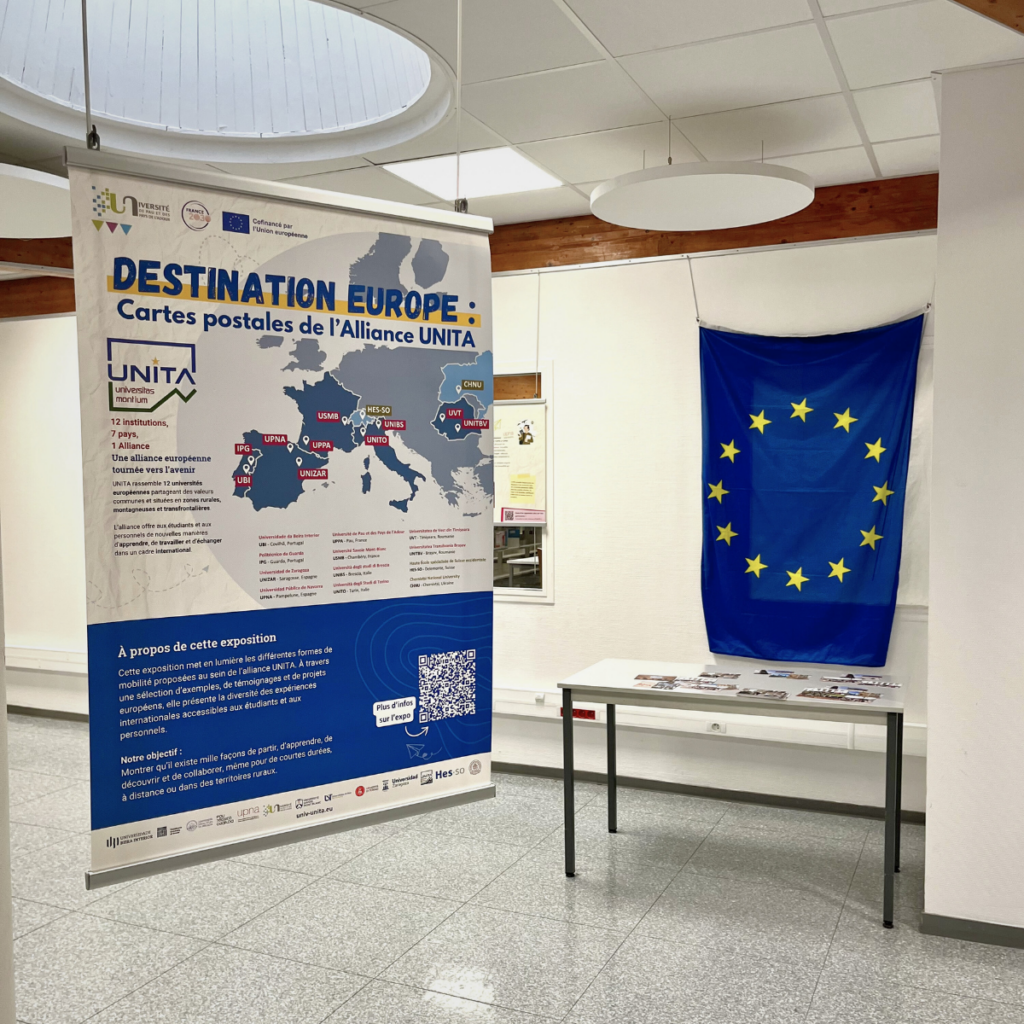
Through the UNITA alliance, students explore Europe while gaining valuable professional and cultural experience. From Alba and Ester’s internships in the French South-West to Laurine’s immersion in rural Spain, these exchanges highlight UNITA’s mission: connecting universities across rural and mountain regions and offering students both career skills and a true human adventure. Des étudiantes venues en stage dans le Sud-Ouest Cet été, deux étudiantes issues d’universités partenaires ont choisi notre région pour leur stage. Alba, étudiante en langues modernes à l’Université de Saragosse, se destine à devenir professeure de français. Après un Erasmus en Bretagne qui a confirmé sa passion pour la langue et la culture françaises, elle a choisi d’effectuer son stage au musée Jeanne d’Albret à Orthez. Elle y a assuré des visites guidées en français et en espagnol, accueillant des publics variés. Mais son implication allait plus loin : Alba a également organisé des groupes de discussion bilingues autour de thématiques inspirées de l’époque de Jeanne d’Albret. Lors de notre visite, les échanges portaient sur… l’école maternelle ! Une manière originale de mêler histoire, patrimoine et actualité, tout en favorisant le dialogue entre visiteurs. Ester, de l’Université de Turin, suit un cursus en langues pour la communication internationale après une licence en tourisme. Elle a déjà une solide expérience dans le secteur, notamment dans l’accueil touristique et le monde viticole. Son stage s’est déroulé au domaine de la Higuère (Vignobles Esquiro), dans le Gers. Là, elle a accompagné les visiteurs dans la découverte des caves et des vins, animé des dégustations, et prêté main forte aux travaux dans les vignes. Le cadre du woofing lui a permis de rencontrer de nombreux jeunes venus d’horizons très différents, et de vivre une véritable immersion interculturelle. Si bien qu’elle envisage déjà de revenir l’été prochain. Parole d’étudiante : Laurine, en immersion en Aragon Si l’alliance UNITA favorise la venue d’étudiants dans notre région, elle permet aussi à nos propres étudiants de partir à l’étranger, y compris dans des territoires ruraux. Laurine, étudiante en 3ᵉ année de droit public sur le campus de Bayonne, a ainsi effectué un stage de plus de six semaines dans la mairie de Herrera de los Navarros, en Aragon (Espagne). Elle raconte : « Mon stage à Herrera a été bien plus qu’une expérience professionnelle : ça a été une aventure humaine inoubliable. » Accueillie au sein du secrétariat de mairie, Laurine a découvert un rôle bien plus vaste qu’elle ne l’imaginait. Loin de se limiter aux tâches administratives, le secrétariat constitue le cœur de la vie du village et un outil essentiel pour lutter contre la dépopulation des zones rurales. Parmi ses missions, elle a participé à la préparation de dossiers de subvention auprès du gouvernement d’Aragon et de l’État espagnol, suite aux graves inondations de juin. Une expérience qui lui a donné une vision concrète de la gestion budgétaire d’une collectivité locale et de la construction de projets financiers. Elle a aussi pris part aux réunions intercommunales de la « comarca », découvrant ainsi les enjeux économiques du territoire, notamment dans le secteur agricole et dans le cadre des programmes européens comme la PAC. Mais son immersion ne s’est pas arrêtée là. Laurine a également collaboré avec un étudiant portugais sur un projet culturel ambitieux : la réalisation d’un documentaire consacré aux enjeux de la « España vaciada » (l’Espagne vidée), phénomène lié à l’exode rural. Ce travail en équipe lui a permis de développer des compétences en gestion de projet, en communication et en travail interculturel. « Pour moi, ce stage a conjugué mon intérêt pour le droit public et l’international, tout en m’offrant une expérience concrète et valorisable sur mon CV. C’est un vrai atout pour mes futures candidatures en master de droit européen. » Sur le plan humain, Herrera est vite devenue sa « deuxième maison » : les repas partagés avec les voisins, les fêtes de village, l’accueil chaleureux des habitants et les rencontres avec d’autres étudiants internationaux ont profondément marqué son séjour. « Participer à un programme de mobilité rurale comme celui d’UNITA est une opportunité exceptionnelle. On acquiert des compétences professionnelles solides, mais aussi une expérience humaine et culturelle unique. Je recommande à tous les étudiants de tenter cette aventure. » UNITA, un ancrage dans les territoires Ces stages s’inscrivent dans la dynamique d’UNITA, alliance qui regroupe des universités implantées dans des zones rurales, transfrontalières et montagneuses. Qu’ils se déroulent dans le Sud-Ouest de la France ou dans les villages espagnols, ils offrent aux étudiants bien plus qu’une expérience académique : une ouverture interculturelle, une professionnalisation concrète et la découverte de territoires singuliers.
The Enhancement of Rural and Mountain Buildings: UNITA BIP “Combined Structural and Energy Upgrade of Buildings in Rural Areas” Between Brescia and Vione

From the 8th to the 12th of September, the UNITA BIP “Combined Structural and Energy Upgrade of Buildings in Rural Areas”, coordinated by Prof. Fausto Minelli, was held between Brescia and Vione (BS). The course, which also included a mandatory virtual component, involved 40 students from 8 different European countries. Organised by the University of Brescia (UNIBS), in collaboration with the Universidad de Zaragoza (UNIZAR) and the Université Savoie Mont Blanc (USMB), the programme focused on the enhancement and rehabilitation of historic buildings in mountain areas. Over the five-day period, participants had the opportunity to explore – through workshops and case study analyses – the historical stratification of the alpine village of Vione, construction and strengthening techniques, the types and origins of materials, the state of conservation of the buildings, and the most commonly used structural systems. The BIP also provided an important opportunity to explore energy retrofit solutions based on the use of geological and bio-based insulating materials, renewable energy sources such as solar power, and innovative technologies including heat pumps and polygeneration systems. The next editions of the course will take place in Chambéry (USMB) and Zaragoza (UNIZAR), with the aim of continuing and strengthening the technical and cultural dialogue on the preservation and sustainable reuse of rural architectural heritage.
Exhibition ‘Digital Archaeology: From Satellite to Ground’
Visit the exhibition “‘Digital Archaeology: From Satellite to Ground’, in the Exhibition Hall of the Facultad de Filosofía y Letras, Universidad de Zaragoza, open until October 31, 2025. This exhibition is part of The HerOn project, which aims to integrate and promote the use of “Digital Twins” applied to architectural, archaeological, and natural cultural heritage, combining satellite, aerial, and terrestrial technologies to enhance its documentation, analysis, and education. The Universidad de Zaragoza and the Universidad Pública de Navarra in Spain, the Università degli Studi di Brescia and the Università degli Studi di Torino in Italy, and the Universitatea Transilvania din Brașov in Romania are collaborating on this project, which takes a multidisciplinary approach encompassing architecture, archaeology, engineering, education, geographical sciences, and legal aspects. In addition, it encourages the participation of cultural institutions, businesses, and society to achieve social impact, accessibility, and inclusion. HerOn represents a step forward in the digital management of European heritage, promoting innovation, knowledge, and sustainability.
UNITA presents its Geminae Network: 19 universities from 11 countries gather at the Geminae Conference hosted by the Universidad de Zaragoza

The Universidad de Zaragoza hosted the event, during which the Best Practices Awards of the Geminae universities were presented. Representatives from 19 Geminae universities of the European Alliance UNITA travelled to Zaragoza on September 4th and 5th to present mobility and collaborative learning projects and to attend the awards ceremony for best university practices. “We share many things: a commitment to sustainability, to our territories, and to the people who live in them,” said Ana Yetano, coordinator of the event. The conference included networking sessions, workshops on rural and virtual mobility, and the presentation of the Geminae network and its research Hubs (Cultural Heritage, Green Energy, Circular Economy and Environment, Digital Transitions, Global Health, and Inclusive Societies). One of the key moments of the event was the presentation of the Geminae Best Practices Awards for Geminae univeristies, which recognised innovative projects from the Universidade Federal de Viçosa (Brazil), the Universidad Nacional de La Plata (Argentina), the Universidad de los Andes (Colombia), the Université de Antananarivo (Madagascar), and the Universidad del Rosario (Colombia). The event concluded with remarks from Sergio Salinas, Vice-Rector for Internationalisation at the University of Zaragoza: ‘I hope these days have been very fruitful for cooperation among all of us, and I look forward to seeing you again soon.’ The next edition of the Geminae Awards is scheduled to take place in Brussels in 2027.
UNITA at European Universities Student Ambassador Forum 2025

From September 4 to 6, 2025, the European Universities Student Ambassador Forum (EUSAF) took place in Warsaw, bringing together student representatives from all European University Alliances (EUAs) for three days of discussions, collaboration, and idea-sharing.The event is part of the EUC voices project and was created to give student ambassadors a real, lasting role in shaping the European University initiative.This year, UNITA was represented by a student from the University of Turin, Mirela Secrieri, who actively took part in the sessions and brought back valuable insights for the alliance. The 2025 edition opened with a session introducing the role of alliances in building Europe’s academic and cultural future: the key messages included the importance of long-term student engagement through alumni involvement and of restoring trust in European projects by placing youth participation at the centre of institutional processes. The second day focused on sharing concrete experiences: students presented posters highlighting best practices from their alliances, including initiatives related to virtual campuses, inclusion, student mobility and cultural events. Interactive workshops allowed students working in groups to design outreach activities aimed at increasing awareness of alliances at the local level. The final day featured insights from past EUSAF participants, who spoke about how the experience had shaped their involvement in their alliances. The forum then turned to open discussion, with students exchanging views on how to improve democratic processes, increase transparency in student representation, and ensure that the outcomes of the EUSAF are communicated both internally and at the EU level. Participants committed in producing a final report or letter to be sent to the European Parliament, summarising the key priorities and suggestions raised by students. The reflections that emerged during the forum will contribute to ongoing work within the alliance, particularly in areas such as student engagement, stakeholder collaboration, and communication strategies. The experience also underlined the importance of continuing to support student ambassadors and ensuring they are empowered to represent and connect with their peers effectively, both within UNITA and at the European level.
Towards an International and Plurilingual University: the University Language Centres meet in Torino

On the 16th and 17th of September, the University of Turin hosted the second stage of the initiative “Towards an International and Plurilingual University: From Intercomprehension to English-Medium Instruction (EMI)”. The event was organised by the University Language Centre (CLA-UniTo) with the active involvement of the University Language Centre of Brescia (CLA – UniBs). Supported by AICLU (Italian ASssociation of University Language Centres), CEL/ELC (European Language Council), and in collaboration with LinE (Language in Education), the Torino meeting brought together Language Centres from UNITA partner universities as well as other Italian Institutions. This two-day convention followed the inaugural meeting held in Brescia in May, aiming to build on that initial momentum. It further reinforced inter-university dialogue and cooperation within and beyond the UNITA alliance. The first day opened with a plenary session, which explored the evolution of UNITA over recent years and concluded with a workshop on the principles and strategies of Intercomprehension, coordinated by the UNITA Task team 2.2. The second day focused entirely on English-Medium Instruction (EMI) – the use of English to teach academic subjects in contexts where English is not the majority’s first language. In the morning, the LinE Centre coordinated a panel discussion addressing EMI language policies and teacher support at Italian universities. Immediately afterwards, the Matching Event for Language Centres took place, serving as a pivotal moment of the event. This interactive session provided participants with the opportunity to exchange good practices, discuss challenges, and identify common priorities. The discussions highlighted the importance of developing digital tools, offering continuous training for EMI lecturers, and establishing stronger inter-university support networks. Thanks to the diversity of perspectives, the Matching Event transformed ideas into concrete proposals for joint action and laid the foundation for future collaborative projects. The afternoon concluded with two parallel workshops: one on EMI, where scholars shared tried-and-tested approaches to EMI teacher development across different contexts, and another on Italian as a Second Language (L2). Overall, the event proved to be a valuable opportunity to strengthen existing collaborations among participants and to forge new professional relationships and networks. Thanks to the active involvement of Language Centres from multiple UNITA partners, the Torino meeting marked a significant step forward in building a truly international and plurilingual university community.
GO-create! UNITA at EAIE Gothenburg 2025

From 10 to 12 September 2025, UNITA took part, for the second year, in the European Association for International Education (EAIE) Conference and Exhibition, held this year in Gothenburg. With over 7,000 participants attending from across Europe and beyond, the event represented a strategic opportunity for visibility, exchange, and international collaboration — and UNITA fully seized it. At the heart of this success was UNITA’s dedicated booth, which quickly became a vibrant hub of interaction and dialogue. Staff members from almost all partner universities co-animated the stand, ensuring constant engagement and offering a rich, multilingual perspective on the Alliance’s mission and initiatives. The booth was not only a physical space, but a true platform for connection — drawing interest from institutional representatives, researchers, and representatives of Geminae partner Universities. Crucially, UNITA’s presence extended well beyond its booth. Representatives of the Alliance engaged in a wide range of activities throughout the EAIE programme, contributing meaningfully to discussions on the future of European higher education. Whether through dynamic presentation formats or collaborative dialogue sessions, UNITA demonstrated a consistent commitment to sharing best practices and fostering innovation in key areas such as rural mobility, community building, and student participation. A standout moment was the poster session on the Rural Mobility Project, which received wide attention — ranking as the second most voted poster of the entire exhibition. Other interventions explored the use of Erasmus BIPs to develop double degree pathways, the role of universities in fostering community engagement, and the co-creation of a shared student identity across European alliances. UNITA also hosted a three networking events with chocolate tasting at its booth, which proved to be a successful and memorable way to combine academic outreach with cultural exchange. Throughout the week, the UNITA booth remained a lively point of connection – a space that effectively communicated the Allice’s values, goals and ongoing projects. The diversity of formats, the professional quality of materials, and the active, coordinated presence of staff from across the member universities contributed to a strong, coherent image of UNITA as a collaborative and future-oriented network. As follow-up conversations unfold and new synergies take shape, UNITA continues to strengthen its role in shaping the future of European higher education cooperation. Discover the activities organized by UNITA for EAIE 2025: https://univ-unita.eu/Sites/unita/en/Noticia/11941 Watch the official video of EAIE 2025: https://www.youtube.com/watch?v=6hY5OmEr0Hw
European Commission Vice-President Roxana Mînzatu visits the University of Torino

The University of Torino had the honor of welcoming Roxana Mînzatu, Vice-President of the European Commission, as guest speaker at the event “Empowering through Skills: The Role of the European Alliances”. The initiative, held on 15 September, was a great success and featured Mînzatu’s keynote speech on the Union of Skills and the EU’s strategies for building the European university of the future. “My presence here is a signal of the European Commission’s commitment to supporting the European University Alliances in their next steps. This is not yet a project, but a process—a true laboratory of European integration.” With these words, Mînzatu, Executive Vice-President of the European Commission with responsibility for Social Rights and Skills, Quality Employment, and Preparedness for Change, opened her speech in the Aula Magna of the University of Torino. The day was dedicated to the future of European universities and to the strategic role of the Alliances in shaping a more integrated and competitive European Higher Education and Research Area. The event, organized by the University of Torino within the framework of the UNITA Universitas Montium Alliance and under the patronage of the Italian Rectors’ Conference (CRUI), brought together representatives from nearly 60 Italian and European universities belonging to 33 Alliances. They shared projects and best practices, with the ambitious goal of building the European university of the future. The University of Torino plays a leading role in this long-term process: among the 65 European University Alliances currently funded by the European Commission through Erasmus+—involving over 570 institutions across Europe—UniTo is the only Italian university serving as coordinator. Moreover, the UNITA Alliance has been visionary in strengthening the European dimension of education. “I would like to congratulate all the members of UNITA,” added Mînzatu, “for taking part in pioneering initiatives and showing the way forward for the entire European higher education sector.” She concluded by reaffirming the Commission’s support: “Europe is backing this ambition, with a planned 50% increase in education funding through Erasmus+ in the next EU budget.” A perspective warmly welcomed by the Rector of the University of Torino, Stefano Geuna: “Education is one of the most important challenges in Europe,” Geuna said, “and we are honored that Vice-President Roxana Mînzatu chose our university to promote the Union of Skills and the strategic role of the European Alliances in creating an increasingly integrated area of research and higher education.” Alongside Rector Geuna, the European Commission Vice-President was welcomed at the Rector’s Hall by Cristina Prandi, Rector-elect of the University of Torino, who will officially take office on 1 October and has made internationalization one of the cornerstones of her rectoral program. The program continued on 16–17 September with the governance meeting of the UNITA Alliance, focused on defining its long-term strategy and working towards the ambitious goal of creating the first confederal European university—an institution fulfilling all university missions and responsible for implementing joint actions.
UNITO, UNITBV, UVT and UNTL join the ASEA–UNINET network during the 20th Plenary Meeting hosted by the University of Brescia

The University of Brescia hosted the 20th Plenary Meeting of the ASEA–UNINET network “For a Peaceful and Sustainable Development” From the 8th to the 12th of September 2025, the University of Brescia welcomed over 100 delegates for the 20th Plenary Meeting of ASEA–UNINET, the network of European and Asian universities founded in 1994. The network’s mission is to foster ongoing internationalization in higher education and research, promoting cooperation and academic diplomacy to strengthen ties and shape the future of education and science. Throughout the meeting, participants engaged in discussions on major global challenges, including climate change, global health, renewable energy, ecological economics, and digital humanism. As part of the five-day programme, ASEA–UNINET hosted a keynote session on European Universities Alliances, delivered by Professor Alessandra Florio Pla, Vice-Rector for International Education at the University of Turin. During the event, the network officially welcomed nine new member universities, including three UNITA partners (UNITO, UNITBV, UVT) and Universidade Nacional Timor Lorosa’e (UNTL), already a GEMINAE partner of the Alliance. This expansion reflects ASEA–UNINET’s ongoing commitment to building high-quality research collaborations and strengthening academic relations between Europe and ASEAN countries.
Seminar “Twin Connections of Digital Cultural Heritage: Building Bridges between Documentation, Analysis, and Education, from Satellite to Field”
Don’t miss the international seminar “Twin Connections of Digital Cultural Heritage: Building Bridges between Documentation, Analysis, and Education, from Satellite to Field,” in the Aula Magna of the Facultad de Filosofía y Letras at the University of Zaragoza on September 30, October 1, and October 22, 2025. Workshops and conferences will be held during the three days of the conference, led by professionals from the universities of the UNITA alliance. Some of the most eagerly awaited lectures include: “An evaluative framework for heritage education: deriving indicators from the National Plan” by Amaia Arriaga (Public University of Navarra) and “3D Digital Mapping Techniques for the Documentation of Cultural Heritage Sites with a Digital Twin Approach” by G. Vassena (University of Brescia). The Universidad de Zaragoza and the Universidad Pública de Navarra in Spain, the Università degli Studi di Brescia and the Università degli Studi di Torino in Italy, and the Universitatea Transilvania din Brașov in Romania are collaborating on this project, which takes a multidisciplinary approach encompassing architecture, archaeology, engineering, education, geographical sciences, and legal aspects. In addition, it encourages the participation of cultural institutions, businesses, and society to achieve social impact, accessibility, and inclusion. HerOn represents a step forward in the digital management of European heritage, promoting innovation, knowledge, and sustainability.