Co founded by the european union logo

UNITA at R&I cross-alliance event in Brussels

UNITA was present in Brussels on October 4th, alongside 13 other European University Alliances to share the results obtained from projects dedicated to research and innovation, such as Research for UNITA (Re-UNITA). Two UNITA representatives had the chance to presented the network of shared infrastructures, set up thanks to the Re-UNITA project.

UNITA at R&I cross-alliance event in Brussels

Les Alliances d’Universités Européennes financées en 2020 et ayant reçu des projets SwafS (Science with and for Socity) se sont réunies à Bruxelles pour présenter les résultats de leurs projets visant à renforcer la dimension R&I des Alliances. Ces projets triennaux arrivent à leur terme cette année ; ce fut donc une excellente occasion de faire le point sur les trois dernières années et de discuter de l’avenir de la dimension R&I au sein des Alliances.

Unanimement, les résultats des Alliances européennes en termes de recherche et d’innovation ont été salués, ainsi que l’esprit d’entraide qui amène un partage effectif des bonnes pratiques et des résultats obtenus entre nos différentes Alliances.

Le programme a porté à la fois sur les principaux résultats des projets et sur l’avenir du financement de la R&I pour les Alliances. 14 Alliances ont présenté les activités qu’elles ont menées et leurs résultats dans des domaines clés : le renforcement du capital humain (soutien aux carrières des chercheurs, évaluation des carrières, développement des compétences, etc.) et les stratégies/politiques communes de R&I (programme commun de R&I, plateformes communes, activités de recherche communes, etc.).

Rosa Bolea Bailo (Vice-présidente de la politique scientifique, Universidad de Zaragoza – Espagne) et Frédéric Marias (coordinateur Re-UNITA, Université de Pau et des Pays de l’Adour – France) ont représenté le projet Re-UNITA et l’Alliance UNITA.

Mme Bolea Bailo a pu présenter le réseau d’infrastructures partagées mis en œuvre durant Re-UNITA, son fonctionnement et ses résultats, en soulignant son élargissement dans le cadre de la phase de consolidation d’UNITA.
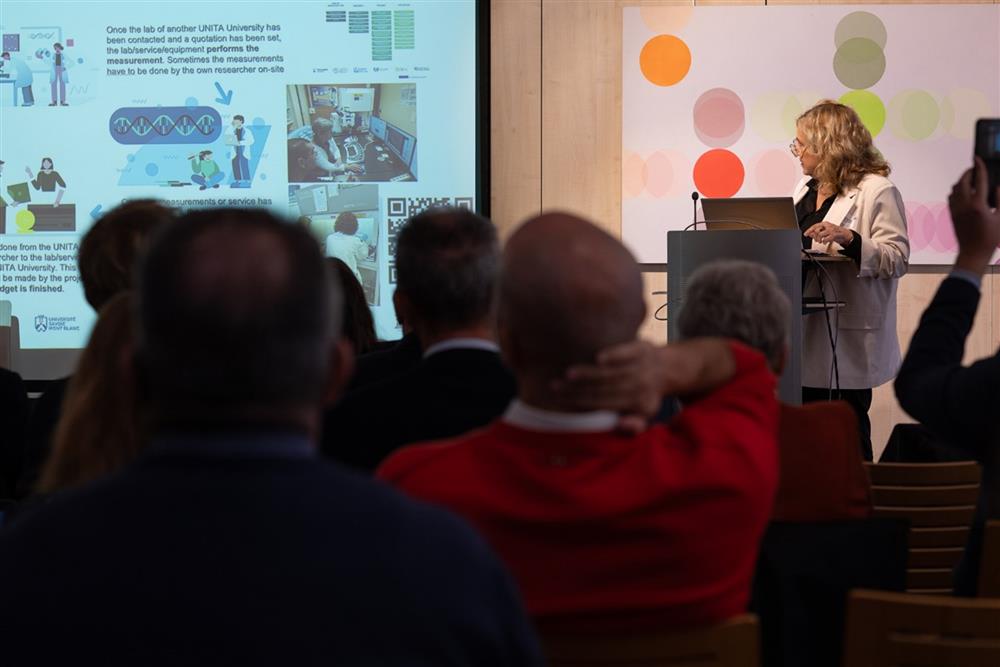
©SimonBlackley

Lors des échanges, l’audience a pu souligner l’engagement politique fort des établissements de l’Alliance UNITA pour mutualiser nos ressources de recherche, et a montré un intérêt fort pour la plateforme numérique mise en place.

En outre, des représentants de la Commission européenne ont participé aux discussions avec les alliances pour aborder les résultats des projets SwafS, mais aussi les futures possibilités de financement de la R&I pour les alliances. L’événement a également été l’occasion d’engager des discussions fructueuses avec le public et la Commission européenne, de partager les bonnes pratiques et de défendre les besoins des Alliances en termes de R&I pour l’avenir. L’événement a donc marqué une étape importante dans l’histoire de l’Europe.
Share the Post:

UNITA’s Inclusive societies Hub is one of the six hubs. Each hub is led by a ‘Task Force’, constituted by researchers representing the member universities.

This task force is animated and coordinated by two universities, Prof. Monica SZELES (UNITBV) , Prof. Patricia ALMAGUER (UNIZAR) and  Prof. Concepción LOMBA (UNIZAR) are the contact points.

Discover here below the Matching events organized within the Inclusive societies hub: 

UNITA’s Global health Hub is one of the six hubs. Each hub is led by a ‘Task Force’, constituted by researchers representing the member universities.

This task force is animated and coordinated by two universities, Dr. Amalric ORTLIEB (HES-SO) and Dr. Donatella Placidi (UNIBS) are the contact points.

Visit the Global Health hub padlet

Matching events for Global Health Hub

UNITA’s Digital transitions Hub is one of the six hubs. Each hub is led by a ‘Task Force’, constituted by researchers representing the member universities.

This task force is animated and coordinated by two universities: Prof. Antonio LOPEZ (UPNA) and Prof. Alexandre Miguel Pereira FIGUEIREDO (IPG) are the contact points.

UNITA’s Cultural Heritage Hub is one of the three hubs, together with Circular Economy and Renewable Energies, each one of them corresponding to one of the three Axes in which research activities in UNITA universities have been divided.

Each hub is led by a ‘Task Force’, constituted by researchers representing the member universities.

This task force is animated and coordinated by two universities, Prof. Laurence Roussillon-Constanty (UPPA) and Prof. Giaime Alonge (UNITO) are the contact points.

Within the research cartography, more than 300+ Cultural Heritage projects can be found, grouped into the following themes and sub-themes:

· Study and preservation of tangible Cultural Heritage
· Intangible Cultural Heritage and identity narratives
· Enhancement and dissemination of cultural and natural heritage
· Innovation policies for the development of marginalised areas

UNITA’s Cultural Heritage Hub

UNITA’s Circular economy and environment hub is one of the six hubs, each one of them corresponding to one of the three Axes in which research activities in UNITA universities have been divided.

Each hub is led by a ‘Task Force’, constituted by researchers representing the member universities.

This task force is animated and coordinated by two universities, Prof. Stefania DIMA (UVT) and Prof. José Maria FRAILE (UNIZAR) are the contact points.

Within the research cartography, more than 200+ Circular Economy projects can be found, grouped into the following themes and sub-themes:

 Activities achieved so far:

  • PhD thesis in cotutelle
  • Microcredentials
  • Summer Schools
  • Research seminars and workshops

UNITA’s Green energies Hub is one of the six hubs, each one of them corresponding to one of the six axes in which research activities in UNITA universities have been divided.

Each hub is led by a ‘Task Force’, constituted by researchers representing the member universities.

This task force is animated and coordinated by two universities, Prof. Benoit STUTZ (USMB) and Prof. Antonio CARDOSO (UBI) are the contact points.

Within the research cartography, more than 120+ projects related to renewable energies can be found, grouped into the following themes and sub-themes:

Energy transformation & Integration – System – Energy carriers
Solar energy
Socio-economic & legal & education aspect
Bioenergy
Geothermal energy
Hydropower
Wind

Activities achieved so far:

  • PhD thesis in cotutelle
  • Microcredentials
  • Summer Schools
  • Research seminars and workshops